
Annex G
Until recently, both Canada and the USA shared the same design standards in fuel tanks. However, a horrific crash in Carseland, Alberta in 1991 lead to new Canadian fuel tank standards. The Carseland crash involved a propane-fuelled school bus that was rear-ended by a transport truck with the loss of three lives. The accident investigation revealed that the tank was a manifold tank and broke where the crossover tubes connected the tanks when the impact drove the tank into the axle. After the investigation was completed, the findings stated that the victims would have been killed no matter which fuel was used. Propane was absolved of any contribution to the deaths. The investigation stated the force of the collision was so extreme that it is unlikely anyone could have survived an accident of this nature. (Information courtesy of the Fuels Forum member C3H8)
The accident review committee did make recommendations that manifold tanks should undergo a crush test to ensure that the connecting tubes would not break in collisions. The propane industry agreed to develop a standard for tanks that would address the issues raised by the accident. The University of Alberta was retained to develop the test. The test required in Annex G now is a variation of the U of A test.
The propane industry convened a committee of manufacturers, equipment distributors, propane distributors and regulators in Alberta to develop the standard to address the issues raised by this accident. A number of issues were brought forward by the parties, not just those pertaining to the crash.
Annex G addresses far more than crush testing. Crush testing is only one of seven requirements that all propane motor fuel tanks must meet:
- Crush testing also only applies to manifold tanks.
- In addition, all tanks mounted outside a vehicle must have a 25% corrosion allowance.
- The tank openings shall have specific protection requirements.
- All tank brackets must be supported with design calculations or physical testing to meet the loading requirements of CSA B149.5 and these calculations must be submitted with the CRN application.
- Valve guards for all tanks must be designed and tested to meet certain impact loads and undermount tanks need to meet the additional requirements that the guard tabs will not fail or deform the shell above a certain amount.
- Name plates must be either on standoffs or seal welded with NDE to prove the weld integrity.
- Finally all vessel appurtenances must be of corrosion resistance construction and compatible with the vessel material.
Examples of tank bracket differences:
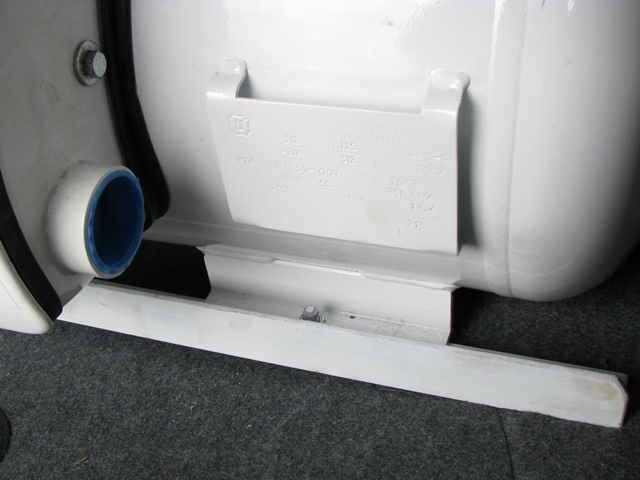
Sleegers 16x36 cylindrical tank installed in an Impala. |
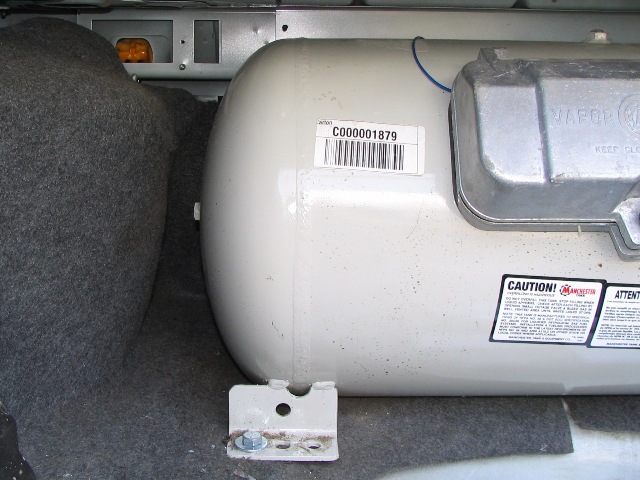
Manchester 16x34 cylindrical tank installed in an Impala. |
Notice that there is much more weld attaching the bracket to the tank on the Sleegers tank. In a severe collision, this means that there is less likelihood that the g-forces from the impact will tear a hole in the tank.